Friday, May 17, 2013

Star Trek Into Darkness


As of now, I have seen Star Trek Into Darkness twice. On my first viewing, I enjoyed it pretty well. On my second viewing... I liked it far less.

Into Darkness is a well-directed action film with plenty of thrills and explosions. The special effects are generally brilliant, the sound design is excellent, and the cinematography is very good. The script, however, is clichéd and pointless. It meanders about its major points without actually making them, and even basic logic seems to be less important than getting to the next scene so we can see something else blow up.

Even the character arcs don't make sense. Kirk is supposed to be learning a lesson, but most of what he does is find more and more clever ways to beat up the bad guys. At absolute most, he learns a lesson about self-sacrifice, but self-sacrifice isn't his problem; it's recklessness. He doesn't learn anything of value in this film.

Spock is no better. Apparently between the last film and this one, he's shut himself off emotionally, leading to conflicts with Jim and Uhura. He and Uhura basically spend the entire movie bickering FOR NO REASON. They end up in the exact same place they were in in the last movie. If they'd broken up, then at least it would have meant something.

Speaking of Uhura, she does basically nothing except worry about Spock and argue with him. She has no meaningful place in this movie. Granted, it's the same with Chekov and arguably Sulu, but at least they have their place and they fit in it very well. Uhura seems like she's given a ton of screen time without reason.

There's also the introduction of Carol Marcus, who seems like she's only there to give exposition and make us all squeal with fan joy because Carol Marcus from The Wrath of Khan is on-screen. Except that she's hardly anything like that Carol, and is probably more notable in the movie for being in her underwear than anything else.

Benedict Cumberbatch's John Harrison, however, is incredibly epic. He perfectly portrays calculating brilliance, brutal savagery, and single-minded domineering focus. Sadly, he actually doesn't get as much screen time as he deserves, which is one of the film's major problems...

As mentioned, I have several major problems with Into Darkness's plot. They get spoilery, however, so if you'd rather skip them, go ahead and scroll down to the second bolded warning.


WARNING: SPOILERS BELOW


Splitting the film's villain duties between Harrison and Admiral Marcus was a mistake. All it does is rob Harrison of the spotlight, keeping him restricted. Hell, Harrison spends a third or so of the movie in the brig doing almost nothing. He's only shown in control on-screen for a select few scenes; otherwise he's nowhere near the masterful villain that Khan was in Star Trek II.

Speaking of Star Trek II, another of the big problems with STID is that it spends so much time aping The Wrath of Khan. Heck, it's in some ways dependent upon The Wrath of Khan. Lines and scenes are directly lifted from Khan, and much of the dramatic weight in Into Darkness comes directly from the audience's supposed knowledge of Khan. It feels quite a bit like what Superman Returns did with respect to Superman: The Movie, and it's just odd. In some places, it's actually frustrating. This is supposed to be a new storyline with a new crew, but it's still incredibly reliant upon the past. There's no reason to revisit The Wrath of Khan unless you're going to build upon that story, not merely echo it.

Something else that bothers me: the writers obviously had a political agenda with the story. Roberto Orci and Alex Kurtzman have been quoted in the past as having purposely put political allegories into their scripts. According to them, the destruction of Vulcan in the first Trek movie was supposed to be equivalent to the Holocaust. Also, the reason they chose military vehicles to represent the Decepticons in Transformers (yeah, they wrote that, too) was to criticize the Bush administration's use of the military. It's a shallow and simple type of allegory, but it's still allegory. Here's how it works in Into Darkness:
-Harrison is Osama Bin Laden: A man who believes he's been wronged by the Federation/USA and begins terrorist attacks on a major city as retribution.
-Admiral Marcus is George W. Bush: A militant leader who uses Harrison/Osama as an excuse to start a war with a third party (Klingons/Iraq) he believes to be a major threat.
-The Enterprise crew are soldiers whose lives are willingly sacrificed by Bush/Marcus in favor of the unnecessary war.
It's not the fact that political allegory is used that's the problem; it's that it goes nowhere. The answer to the entire problem seems to be "let's just blow up all our problems, unless it's to our benefit not to."


SPOILERS OVER


Into Darkness is a Star Trek film that seems to be asking its audience not to think. As any Star Trek fan can tell you, that is as close to blasphemy as Trek can get. The Star Trek franchise is a shining beacon of sociopolitical commentary, philosophical discussion, and inspirational metaphor. Star Trek Into Darkness is a popcorn blockbuster with lots of explosions and nothing of true substance. While this isn't a cardinal sin, it does mean that this film falls well short of the mark. It's not nearly as bad as the worst of the Trek series (TMP, V, Generations, Nemesis), but it's nowhere near the top five either. It sits comfortably in the middle, neither gaining nor losing anything. It remains a stagnant point for Star Trek, and after waiting these four years since Star Trek's 2009 release, that is completely unacceptable.

5/10

Friday, January 20, 2012

Underworld: Awakening

This is a near-totally shallow action movie that still manages to be fun.

Since the events of Underworld: Evolution, things have changed quite a bit. Humanity has discovered the existence of the vampires and lycans, and is now attempting to eradicate them. Selene and Michael are captured and frozen, Han Solo-in-carbonite-style. Thirteen years later, Selene wakes up but Michael is missing. Selene then begins searching for Michael, uncovering a lycan conspiracy and slaughtering hundreds of people along the way.

The Underworld series has never really been all that great. At best it's been "okay." Its real strengths were its well-thought-out mythology and the star power of Kate Beckinsale; its weaknesses were its direction and lackluster scripts. Awakening doesn't get any better in any of those categories, but it does have enough straightforward action to more than make up for the lack of real emotional drama. All this movie really has going for it is a story that's just good enough to justify the action, which is really fun.

Another interesting note is the fact that the 3D version of the movie is actually done very differently from most 3D movies.  While most 3D films merely give a bit of "depth" to the movie, allowing the audience to tell which objects are closer or farther away, Underworld turns the 3D depth up way more than most other films even dare. The result is something that actually feels less like a movie and more like just "being there." It's surprisingly enjoyable.

If you're an Underworld fan or someone who just likes the thought of spending two hours watching Kate Beckinsale in black leather shooting people, Awakening is worth watching.

6/10

Sunday, July 24, 2011

Captain America: The First Avenger

This very well may be the most fun movie to come out this Summer.

Captain America: The First Avenger harkens back to classic adventure films that are rarely—if ever—made today. It feels more Indiana Jones than Saving Private Ryan, to its credit. It's not even attempting to reach the hyper-realism of The Dark Knight, which does the film a service. Too often today do we get dark, gritty films that teach us the lower limits of humanity, when we truly need an uplifting tale that shows us the very best within ourselves.

Captain America is remarkably family-friendly. There's little more than a "hell" or "damn" thrown in, and almost no on-screen blood. It's refreshing to have a modern superhero film that goes back to the made-for-all-ages heart of the original comics—and still with enough depth to keep the adults just as entertained as their kids.
Chris Evans was an odd choice to play Steve Rogers, mostly because he had already played The Human Torch—another Marvel hero—whose personality is the polar opposite of his character here. And yet, here he completely reverses his usual acting persona, playing the ultra-idealistic, honor-and-respect-driven Captain America perfectly. He feels completely genuine in every single scene, and he owns the movie entirely.
Of special note is the bogglingly real "skinny Steve Rogers" camera/CG/probably-magic effect that makes Chris Evans look like an actual skinny short guy in the scenes before he is physically transformed into a super-soldier. (did I just invent the word "bogglingly?" Maybe. Cool.)

The supporting cast is surprisingly good. Hayley Atwell plays Peggy Carter with a sharpness that evokes similar hard-edged comic characters like Lois Lane. She doesn't feel forced into the plot like other superhero love interests, and actually has a believable chemistry with Steve.
James "Bucky" Barnes is the secondary character that's given the most depth, despite the fact that he gets a bit less screentime than Peggy, Erskine, and Phillips. He's got just the right amount of tough attitude, depth and likable comedic timing. He's also a great action hero character. More than anything, however, it's his friendship with Steve that really makes Bucky remarkable here. They feel like brothers, and it really helps to personalize the movie. For fans of the comics who know Bucky and his history, seeing him—and specifically the events that affect him in the movie—is a special treat.

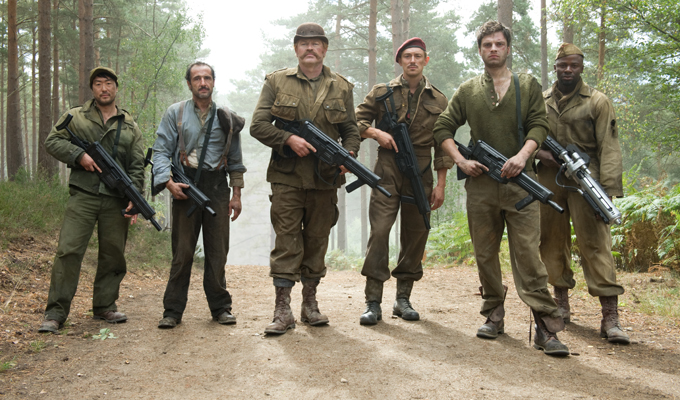
The other side characters, including the scientist Abraham Erskine, Col. Chester Phillips, Iron-Man's-dad Howard Stark, and the rest of Cap's team known as the Howling Commandos (never named in the film), are all well-acted and plenty-enjoyable to watch.
The antagonist, Johann Schmidt—The Red Skull—is the very definition of a power-mad evil villain. He's so incredibly perfect in his archetypal portrayal that he and Cap are the perfect balance, as well they should be.

The action in this film is exactly how comic fans always imagined it would be: stylized, slightly unrealistic (in a good way), and extremely cool. There's nothing quite like the glee you get when Cap throws his mighty shield into a Nazi and it bounces back into his hand. It's sheer comic book magic.

The movie isn't without a few problems. There's a framing storyline that's a bit underwhelming, and the final moments of the movie act as more of a setup to 2012's The Avengers, rather than rounding out this particular story itself.
While this film is the very definition of good, honest fun, it's not quite on the level of perfection that Raiders of the Lost Ark and Indiana Jones and the Last Crusade mastered. Then again, not being as good as the two best Indy films isn't really saying very much.

In the end, Captain America is an awesomely fun movie. It's definitely one of Marvel Studios' best, and may go down as one of the best superhero films to date.

9/10

Thursday, June 30, 2011

Update (6/30/11)

New reviews:
Daredevil
Green Lantern
Green Lantern: Emerald Knights
X-Men

I felt like delving into the Green Lantern and X-Men franchises this month because of their current films in theaters. Daredevil was just a random whim that came out of nowhere.
Next up is Transformers: Dark of the Moon, just as soon as I get the chance to go see it. Otherwise, the next few films will probably be X2, Tangled, Thor, and whatever else I get around to.


Upcoming reviews:
Green Lantern: First Flight
Harry Potter and the Deathly Hallows, Part 1
Harry Potter and the Goblet of Fire
Harry Potter and the Order of the Phoenix
Harry Potter and the Prisoner of Azkaban
The Hunchback of Notre Dame
Juno
The Lion King
The Matrix
The Matrix Reloaded
The Matrix Revolutions
Mulan
Pirates of the Caribbean: Curse of the Black Pearl
Pirates of the Caribbean: Dead Man's Chest
Pirates of the Caribbean: At World's End
Pirates of the Caribbean: On Stranger Tides
Pocahontas
Quantum of Solace
Serenity
Spider-Man
Spider-Man 2
Spider-Man 3
The Spirit
Sucker Punch
Superman: The Movie
Superman II
Superman III
Superman IV: The Quest for Peace
Superman Returns
Tarzan
Troy
X2: X-Men United
X-Men: First Class
X-Men: The Last Stand
Tangled
Thor
Wonder Woman (2009 Animated)

Movies I have yet to see this year:
Transformers: Dark of the Moon
Harry Potter and the Deathly Hallows, Part 2
Captain America
Cowboys and Aliens
The Muppets
Mission Impossible: Ghost Protocol
Sherlock Holmes 2

Friday, June 17, 2011

Green Lantern

For those who don't know, I am a huge fan of the Green Lantern character and comics. I've read the original story upon which this film is based multiple times, and enjoyed it greatly. I wish I could say the same of the film itself.

The basis for Green Lantern is this:
On the distant planet Oa, the guardians of the universe created the Green Lantern Corps, a group made up of 3600 individuals recruited from across the universe. Using their green power rings—technological weapons of incredible strength, fueled by their user's willpower and imagination—they act as intergalactic policemen, keeping innocents safe from various threats.
Hal Jordan, an overly cocky fighter pilot, has now been recruited as the first-ever human Green Lantern. Meanwhile, Parallax, a massively powerful and evil being made of pure fear, is on a course headed for Earth. Hal must deal with his own personal fears before being able to successfully wield the ring's power and defeat Parallax.

The bizarre thing about this film is that it gets so much of the Green Lantern universe right, but doesn't make it interesting. Hal Jordan's story is somehow robbed of its emotional resonance from the comics, despite the fact that most of the story is exactly the same. It's the little moments that are missing; the ones that show Hal as a compelling character. The same goes for every other character in the film. The audience is simply never given a reason to care about any of the main characters.


The best scenes on an emotional level are the romantic bits between Hal and his former girlfriend, Carol Ferris. While Carol is perhaps shown too often as nothing more than a support for Hal, her scenes are genuinely sweet. One moment in particular is notably hilarious, and contains the best genuine laugh in the entire movie.

The script in this movie is awful. Every single line is terribly bland. Hal is somewhat funny, but it seems as though most of that humor was due to Ryan Reynolds' improv skills and comedic timing. The overall story and editing are terribly problematic as well. The film jumps back and forth between plotlines in ways that are more frustrating and distracting than anything else. Furthermore, the interesting plotlines (those involving the Corps) end up going nowhere. Certain plot twists come up only in order to set up a sequel, and the main villain isn't even a real character.

Parallax isn't a character; he's just a giant puffy-headed death cloud. The only character that's actually developed as a villain is Hector Hammond, but he's more of an annoyance in the film than anything else. He's not interesting, he's not fun to watch, and he only distracts from Hal's story.

Mark Strong plays the character of Sinestro, a fellow Green Lantern from another sector who has more militaristic—and perhaps even immoral—ideas about the Corps and how it should operate. He's a hugely important character in the Green Lantern mythos, but gets nothing more than mere setup here. Furthermore, his relationship with Hal Jordan, a very important character and story point, is entirely glossed over here. Mark Strong plays the hell out of Sinestro with what little screentime he has, but it's not enough. This is a character that deserved much, much more.

Still, however, there are enjoyable things about the movie. Seeing Hal Jordan use his power ring in superheroic ways inspires a bit of childlike glee. The action, for what little is there, is fun. It's that tiny bit of enjoyability that saves Green Lantern from being terrible. And, to be fair, there's nothing in Green Lantern that's particularly offensive; it's just extremely bland.

The eight-year-old in me wants to give this movie a six out of ten. The twenty-one-year-old in me wants to give it a four. I'll split the difference. Let's just hope that if and when a sequel is made, it's better than this one.

5/10

Tuesday, June 7, 2011

Green Lantern: Emerald Knights

Emerald Knights is a not-sequel to the previous DCUAM Green Lantern movie, First Flight. It uses the same animation models with a new voice cast and story continuity.

This is a jumbled bag of a movie. First of all, it's an anthology film, consisting of several different stories all placed within a framing story.
The framing story, with Hal Jordan mentoring young Arisia, a new Green Lantern recruit, is passable. It's not very interesting, and feels more annoying than anything else. A straight-up series of short stories presented separately might have been more interesting than this.

A few of the short stories are enjoyable. Laira's story is decently emotional and very well-choreographed. The opening story, focusing on Avra, the First Lantern, is adequate.
Most of the stories, however, are passable at best. Additionally, a few of these stories have been told before in the comics, with a mere few pages each. Those original comic versions, which only took a mere two minutes each to read, were more compelling than these animated tales are, despite their ten-to-fifteen-minute runtimes.

Most confusing of all is the fact that Emerald Knights looks exactly like First Flight, but is clearly not in the same continuity. Seeing the same characters but with drastically different voices doesn't help, either. Some fare better than others. Nathan Fillion has a great voice for Hal Jordan, and some of the side characters, Arisia and Laira, never had major speaking roles in the first film anyway. But others, like Sinestro, Kilowog, and Abin Sur just feel bizarre with their new voices. It's incredibly distracting, and not at all enjoyable.


If you're a huge Green Lantern fan, this could be worth your time. Otherwise, skip it.

4/10

Friday, June 3, 2011

X-Men: First Class


Let me preface this by saying that I am a very big fan of the first two X-Men films (the ones directed by Bryan Singer), and to some degree, the franchise as a whole. The night I saw the first X-Men film is forever locked into my memory as a huge moment in my childhood. X2 is one of my favorite superhero movies, possibly tied for my favorite overall. I haven't been a fan of either of the X-Men films after X2 (X-Men 3 and Origins: Wolverine were, to put it mildly, garbage), but I will always love the X-Men at their best. First Class, being produced by Bryan Singer, had all the potential in the world to return to the high standards of quality seen in those earlier films—or at the very least, one would expect it to respect those films. How odd is it, then, that First Class seems in some ways to do the opposite?

X-Men: First Class is a blending-together of the scripts for two separate X-Men films, one being a Magneto/Xavier origin story and the other being a film about the "first class" of young X-Men. Apparently one of these scripts was very good and the other wasn't. The Magneto/Xavier moments in First Class are largely good, while the moments with the teen trainees are largely boring.


James MacAvoy and Michael Fassbender are absolutely perfect as the young Charles Xavier and Erik Lensherr. Their performances are by far the strongest aspect of the film as a whole. Perhaps wisely, they take their cues more from the comics' portrayal of the characters than the past films', but without contradicting the film versions either. It's rather masterful, really. Their story isn't as good as their acting, but it's good enough for the most part. If there's any aspect of First Class that definitely deserves to be held up as one of the best elements of the series, it's these two characters.

Unfortunately, most of the other characters are either useless or ill-portrayed. Nearly all of the other X-Men are, at best, C-list characters that frankly don't deserve to be part of the so-called first class. Instead of classic characters like Cyclops, Jean Grey, Angel, or Iceman, we get Cyclops' kid brother (who is somehow older in this continuity), a different character coincidentally named Angel (whose most notable trait is that she's a stripper with an attitude), Banshee (an Irish kid with screaming powers who we are given zero reason to care about), and a random guy named Darwin who is almost literally in only one scene before dying. The only one of the teens that's particularly compelling is Hank McCoy/Beast, who it should be noted is the only member of the team that was actually part of the first class in the comics. His story actually works very well, even if his blue furry makeup very much does not.

The villains of the story are varied. Kevin Bacon's Sebastian Shaw is largely very good, and a rather fitting villain for the story. The presence of the demon-mutant Azazel is also rather welcome, as he fills the "super-cool silent evil henchman" role well while also referencing continuity (Azazel being Nightcrawler's father). The other villains, however, are terribly bland. Riptide's only use seems to be generating badly-rendered CG tornadoes and filling camera space next to other more important characters, while Emma Frost—a huge character from the comics—is so badly-acted and -written here that it's painful for an X-Men fan to watch. Emma in the comics (as well as in the various animated series) is a cold, commanding, brilliant, and powerful character. Emma in First Class is essentially Sebastian Shaw's whore and little else.


The biggest issue with First Class is how it handles continuity with the other films. Normally, continuity shouldn't be such a big issue, seeing as how, at the very least, the film should be able to stand on its own terms, irrelevant of how it fits with everything else. However, in this case the continuity is central to the story and can't be ignored. Many elements of First Class directly call out continuity, setting up characters and events precisely to line up with the other films. A couple of actors from past films even make cameo appearances. There is no way that this is meant to be a "reboot" of any kind; this is a prequel, plain and simple. The problem is that while it definitely wants to be a prequel, First Class outright contradicts so much continuity that the emotional ties it draws to the past films actually hurt the experience more than help it. Apparently the reason almost no classic X-Men characters were used in the film is that chronologically they would have been too young for the era in which the film is set, requiring a different set of characters. Yet other elements of the story seem not to care about things like ages, sequences of events, etc. Here's a list of some of the biggest continuity contradictions:

-In X2, the main threat revolves around the fact that Magneto helped build Cerebro and is capable of building it again from memory. In First Class, Hank builds it and Magneto knows nothing about it.
-In both X-Men: The Last Stand and X-Men Origins: Wolverine, Xavier is shown as an older man (in either the 1970s or the 1980s) able to walk, yet we see him paralyzed in 1962.
-In the first three X-Men films, it's said that Xavier and Magneto met as teenagers and spent years working together. In First Class they meet as adults, work together for a several months at most, then part ways—notably before they meet Jean Grey in the prologue of The Last Stand.
-While not technically a continuity error, it seems odd that Mystique and Charles grew up together for eighteen years as brother and sister, yet this is never referenced at any point during the other films. Given how incredibly close First Class's Mystique is portrayed to the trilogy's version of the character, it seems very ill-fitting to make her Xavier's sister. Why would Xavier repeatedly mention his close friendship with Magneto that only lasted a few months, but never reference Mystique being his adopted sibling?

Ignoring the contradictions in continuity for a moment, perhaps the thing that disappoints me most about First Class is that it handles many important parts of the X-Men mythos so poorly. As mentioned before, the "first class" of X-Men are mostly poor, useless characters that do not live up to the X-Men name. Charles and Erik don't have a long, legendary partnership; they barely know each other, really. "Magneto" is a nickname given to Erik by a bunch of rowdy partying teenagers. Emma and Riptide shouldn't have even been allowed to grace the screen.

Now, as for scoring the movie, I'm going to try to remain more objective. As an X-Men fan, it's hard to see First Class as anything but a disappointment with some high moments. However, putting aside my personal bias, it is at least a pretty decent film. The two leads and the main villain are very good, the plot is good, and production values are decent enough.

In terms of personal enjoyment, I can't give First Class anything more than a four out of ten. On a somewhat more objective scale, it probably deserves something closer to a six.

6/10

Friday, December 17, 2010

TRON: Legacy

TRON.  Wow.  TRON!

I remember being thirteen when I saw TRON for the first time.  I loved it.  It was an 80s cheesefest, sure, but it was captivating in the way that it blended the colorful whimsy of Disney fantasy, the technical detail of computing, the fun of arcade gaming, and the style of 80s filmmaking.  In many ways, TRON taps into something highly personal within those of a certain generation.
TRON has been somewhat relegated to the hardcore geek crowd for the last decade or two, and no one ever really believed that a sequel would ever be made.  Now, 28 years later, seemingly out of nowhere, comes TRON: Legacy.


Essentially, the gist of the original TRON was that Kevin Flynn (played by Jeff Bridges), computer programming genius, accidentally became "digitized" into a computer. There, he discovered a neon-colored world much like our own, where "programs" are individuals in the form of people. Kevin meets a security program named TRON, and helps him defeat the evil Master Control Program. In TRON: Legacy, Kevin Flynn has mysteriously disappeared, leaving his only son, Sam, to grow up alone. Now, after being without his father (or the answers behind his disappearance) for twenty years, Sam stumbles upon the world inside the computer and discovers that his father has been trapped inside the system by a malevolent program called CLU, who is created in Kevin's exact image. Sam, Kevin, and a female program named Quorra must fight CLU and escape from the digital world.

So that's about it. Lots of electroluminescent sci-fi action adventure.

Here's an interesting thing about Legacy: in contrast to the first movie, which was very bright, colorful, and fun, Legacy is rather dark and subdued. The tone is (for the most part) very serious. It works out alright, but I can't help feeling that the film would have been better-served by a faster pace and more "fun" vibe. As it is, it's okay, but it borders on being actually boring at times, which is something you never want to see in a movie about neon-colored people throwing laser-edged frisbees and riding digital motorcycles.


An unusual trait of the TRON films is that the visual effects, while not entirely flawless, feel somehow perfect. Because these events take place inside a computer world, it only makes sense that they should look computerized. After all, they are computer-generated.

The look of the TRON world in general is very different from the original film. While the original film had bright colors and characters that glowed as though made of light itself (and showed the programs to be actual beings of energy), Legacy alters this considerably. Legacy's world is dark—fitting, for this darker story—and its characters are shown to look like regular humans who merely wear clothing with a few glowing stripes. While I like the sleeker nature of the suits—especially the lack of the dorky helmets—the character designs in Legacy are almost boring by comparison to the first film. It's a fundamental change to the TRON universe, and I'm not sure I like it.

Old:

New:


The action scenes, while perhaps sparse, are generally well-done, and highly unique. They challenge the audience to wrap their heads around ideas of physics and energy that contradict real-world norms, much like The Matrix did in 1999.

The music of TRON: Legacy, composed primarily by Daft Punk, the world-renowned electronic music duo—is merely adequate at some times, but astonishing at others. Whether with electronic beats or orchestral swells, the soundtrack of Legacy is, overall, an amazing work of art. Some have said that the entire focus of Legacy is the sound, and I'm not inclined to disagree.

The characters of Legacy—Sam, Kevin, Quorra, and CLU—are all very well-acted. None of them really grip the audience the way that Kevin did in the first film, mostly due to the movie's subdued tone. One rather unique aspect of Legacy is the way that a younger version of Jeff Bridges is recreated through the use of extensive facial motion-capture and digital animation. The "young Jeff Bridges" looks astoundingly realistic in still photos, but in motion looks very obviously fake. At the same time, however, Jeff Bridges' acting manages to shine through in his motion-captured performance, giving the CG character a kind of emotional depth that counteracts the fakeness of the digital model.

One interesting note: the character of TRON from the first film does not factor into this film's story in any major way. In fact, the small ways that TRON is referenced in Legacy feel almost confusing to fans of the first film, since he's put in a position to have a much bigger role in the film than he does. It's almost definitely certain that he will return in a sequel (if such a sequel is made), but until then, this is just confusing.

All in all, TRON: Legacy is a rather mixed bag, yet is still quite remarkable. There's a sizable amount of depth in the film and its story, concluding with a curveball surprise at the end. While there's a part of me that loves TRON and wants to love TRON: Legacy, in the end I can only say that I like it.

7/10

Friday, August 13, 2010

Scott Pilgrim vs. the World

This is a movie about a boy (Scott) who likes a girl (Ramona).  But, as it turns out, in order for Scott to date Ramona, he must defeat her seven evil ex-boyfriends in awesome anime/video game/comic-book battle.

Now, before I go further, it's probably best that you watch the trailer for the movie.  Watched it?  Okay, sweet.

Scott Pilgrim is based on the comic book series of the same name.  It's a brilliantly-written comedy/drama about a 23-year-old boy named Scott and the insane adventures that he and his friends go through.

The movie manages to capture a lot of what makes the book so special.  It's got that same feeling of "non-reality" from the comics, which is impressive.  The cast, for the most part, is spot-on with the book, to the point where you can merely glance at any of the actors and say "ah, they're that character."

There's a few oddities, though.  First off, the plot is so condensed (squeezing six thick volumes of the comic into two hours of film) that the "high points" of the comic become the standard tone for the book.  Whereas the book was maybe 70% "normal" and 30% "crazy", the movie is about 20% normal and 80% crazy.  It's not a huge problem, but it does get to a point where the rapid-fire insanity is almost tiring.

Another problem with the film is that the sixth and final volume of the comic was not yet completed at the time of filming, and thus the film's ending is slightly different.  Both versions end up the same in the end, but certain very important details are left out.

The two lead characters, Scott Pilgrim and Ramona Flowers, are portrayed somewhat oddly.  While Mary Elizabeth Winstead's portrayal of Ramona is spot-on, most of the truly important scenes for her character are left out, due to the altered final act of the film.  Without this, Ramona is left as a somewhat bland and misunderstood character.

Michael Cera should never be allowed to play anyone in movies again.  Ever.
Scott in the comics is a lazy, geeky, sometimes-energetic, slightly-dorky-yet-lovable guy.  In the film, he's a dopey, selfish jerk.  Cera's portrayal makes Scott look like he's just an arrogant, insecure jackass.  The dialogue is exactly the same as in the book, but somehow Cera manages to make it seem terrible.

Now, aside from the (negative) comparisons to the original book, the movie is highly entertaining.  The visual style alone makes the movie worth watching, but the dialogue and overall story make the whole thing border on the edge of brilliance.  If the last act had retained the emotional closure and character depth that it should have (and Cera hadn't been cast), the film would be amazing.  As it stands now, it's just "really fun, and pretty good."

7/10

Thursday, July 1, 2010

The Last Airbender


...Look, I... I just don't want to write this. It's not worth my time.

I love the animated series upon which this movie is based. But I loathe this movie. It takes all the magic, heart, drama, humor, excitement, energy, and fun out of the show, and replaces it with slow, stupid nonsense that does nothing but frustrate.

I could rant about how bad this movie is for a lot longer. I could mention how details, big and small, are changed from the series for apparently no reason, angering fans. I could talk about the bland acting, or the fact that there are literally NO scenes in the movie that serve as anything other than exposition. I could mention the stupidly-choreographed action scenes, which stand in contrast to the series' jaw-dropping fight scenes.

But no. I've already wasted more energy typing this review than this movie deserves.

0/10

Friday, May 7, 2010

Iron Man 2

Iron Man 2 isn't bad, and it's not exactly great. It's just "decent."

When last we left our armored hero, he had gotten over his insane ego and become a more responsible person. In the span between the last film and this one, he's somehow become even more narcissistic than he ever was before.

That's essentially the crux of the entire movie: Tony Stark's ego. While there are genuine reasons for his self-destructive behavior, it still seems a bit much to swallow, and it makes Tony harder to enjoy as a character.

In the last movie, a combination of cleverly-written dialogue and well-acted improv banter between the actors kept up a certain charm. This time around, the dialogue's charm is wholly dependent upon the actor improv, and it constantly stumbles.

The plot is also rather weak. It lacks the simplicity and power of the first movie's plot, and feels like it's running in circles.

One particularly bizarre element is the introduction of two characters, Natasha Romanov (AKA Black Widow) and Nick Fury, who only show up in order to better set up their future appearances in The Avengers. Nick Fury makes a moderate amount of sense here, given that he was set up in the post-credits sequence of Iron Man, and SHIELD had played a supporting role in that film as well.

Romanov, however, is a strange twist. Scarlett Johannson plays Black Widow considerably different than her comics counterpart, lacking the distinctive Russian accent and personality. She feels more like "Scarlett Johannson in a black suit" rather than the actual Black Widow character.

Of course, for all the movie's faults, it's still decent fun. The special effects are great, the action (what little there is) is good, and the story is just decent enough to keep the audience's interest.

Iron Man 2 isn't a great film, but it's not bad either.

6/10

Friday, April 16, 2010

Kick-Ass

What would happen if someone actually tried to be a superhero?  What would happen if you just put on a costume and tried to fight crime in the real world?
Answer: you'd get your ass kicked.

This movie is one of the most violent and vulgar films I've ever seen.  There's f-bombs casually thrown into virtually every other sentence, and the violence just gets more and more extreme as the film goes on.  There's nothing vomit-inducing, but it's pretty intense.  At the same time, however, the heavier the action gets in the film, the more stylized and "comic-book" it gets, which keeps it from simply getting disgusting.  There's also some sexual humor in the first half of the movie, though it's not "extreme."  All that to say that there will be many who are completely offended by the movie, and I don't fault them for that.  Heck, I don't even recommend the movie to anyone who's not a male over the age of 18, and even then I'm selective about it.  So yeah, there's my disclaimer.  Read my review and watch the film at your own risk.


The film's story centers on Dave Lizewski (center above), an "average" and "unremarkable" teenager in every sense.  He and his fellow comic book nerd-friends simply live their lives, going from one stupid and unremarkable day to the next.
One day, Dave asks the question: why hasn't anyone actually put on a costume and tried to be a superhero?  His friends quickly give him the obvious answer: "because it's f***in' crazy, man. you'd get your ass kicked."
Later, after being the victim of a mugging, Dave decides that enough is enough.  He puts on a bright green full-body wetsuit, grabs a tactical baton, and goes out to actually fight crime in his neighborhood, under the name "Kick-Ass."  He gets beaten to the edge of death.

Somehow, this only strengthens his resolve, and he returns to his vigilante ways.  He doesn't get his ass kicked quite as badly this time, and actually manages to become somewhat of a local hero in the process.  His situation gets more and more complicated, however, when he discovers that he isn't the only costumed hero on the streets, and inadvertently gets involved in a bloody war between the father-daughter vigilante duo of "Big Daddy" and "Hit Girl" and their nemesis, crime boss Frank D'Amico.

Perhaps the most remarkable and amazing character in the film is Mindy Macready ("Hit Girl"), an eleven-year-old foul-mouthed super-assassin.  She's simultaneously adorable and jaw-droppingly fierce.  She steals every single scene, and is constantly entertaining.  Seriously.  Little girls like this are why I'm slightly wary of my ten-year-old cousin.  (I'm pretty sure she could kill me if she wanted to. o_o )


Nicolas Cage also stars in this film, and, for once, does a great job.  He's absolutely perfect as Big Daddy, who's essentially a cross between Adam West-Batman and The Punisher.
This film has made me actually like Nick Cage, which is just amazing.  I mean, it's NICOLAS CAGE.  The guy who SINGLE-HANDEDLY RUINS MOVIES.  The BANE OF SUPERHERO FILMS.  And yet, somehow, he totally rocks this role to the very core of awesomeness.

A weird switch occurs in the middle of the movie, where it goes from following the non-lethal adventures of Kick-Ass to also following the exploits of Big Daddy and Hit Girl, who unremorsefully slaughter their criminal opponents.  Once the switch is made from "Batman" to "Punisher," however, it all works wonderfully.

Kick-Ass balances comedy with action and drama to such a fine degree that it's exquisitely entertaining for those few that aren't bothered by the heavy content.  This is the first movie I've seen in a long time that I've enjoyed this much.  Even though I have some severe reservations about some of its more extreme content, I still can't help but love the film.

It really does kick ass.

(come on, you thought I wasn't going to use that pun?  It's just too easy to pass up...)

9/10

Friday, August 7, 2009

G.I. Joe: The Rise of Cobra


This movie is a jumbled mess. Stephen Sommers has directed better films in the past, but Rise of Cobra is just a schizophrenic nightmare.

Sommers' past films--notably The Mummy--managed to keep a comfortably brisk pace while still making the audience care about the admittedly-silly characters.  G.I. Joe, on the other hand, seems content to completely focus on the action.  There are many flashbacks that explain the backgrounds of several characters, but most of those scenes are more annoying than interesting.

The action scenes are decent, though there's nothing to rave about.  The special effects are pretty terrible, though that might simply be because of "style."  The entire film comes across as a live-action cartoon in nearly every possible way.  However, there's a rather large amount of swearing and a violence for this to be considered a childrens' film, which is rather odd. One wonders what exactly the target audience was for this movie.

In all honesty, there's not much more to say about the film.  It's not terrible, but it's not great.

4/10.

Wednesday, July 15, 2009

Harry Potter and the Half-Blood Prince

Watching Harry Potter and the Half-Blood Prince is like living through a melancholy dream. Even more than The Order of the Phoenix, this film is nearly devoid of bright color, reflecting the dreary mood of the story. This is actually rather strange, as Order of the Phoenix ended on a slightly upbeat and hopeful note. However, as a mostly melancholic, subdued film, The Half-Blood Prince is wonderful.
Right from the start, it's obvious that this is one of the most visually-impressive fantasy films ever created. The cinematography never ceases to amaze, and the extreme level of detail and realism that accompanies the already-striking artistic style rivals that of the Lord of the Rings films. It's especially satisfying to watch the perfectly-rendered Quidditch match in this film and realize just how far the visual effects have come since The Sorcerer's Stone. Each magical spell, gust of snow-filled wind, and billow of black smoke looks perfectly realistic.
Despite the dark tone of the overall plot, this actually may be the most genuinely humorous Potter film. For a good 80% of the movie, the main characters have little more to do than simply live their lives. It might sound boring or pointless, but there's so much character development and genuine humor that it's completely entertaining the whole way through.
One surprising—but not unwelcome—aspect of the story is the heavy emphasis on the close, loving relationship between Harry and Hermione. It's touching in an unexpected way, and goes to show just how strong their friendship really is.
Even Draco Malfoy is given more depth, as we see for the first time that he is a conflicted character, rather than a one-dimensional bigoted bully.

The Half-Blood Prince is not entirely without disappointments, however. While the dark seriousness of the story is not necessarily a bad thing, it does take away some of the "punch" that The Order of the Phoenix excelled at.

Another problem with the film is the fact that it lacks a real ending. While The Order of the Phoenix managed to create a conclusion where one really didn't exist, here we don't even have any sort of closure at all. Although we are told exactly where the characters are going and what's happened at the end, we still don't have the emotional closure that is necessary for the film to work on a purely emotional level. This very well may have been the intent of the filmmakers, as Dumbledore's death is meant to be an emotional blow, but the simple fact is that the ending is not satisfying. It feels as though we are given an invisible "to be continued" message when we shouldn't have needed one.
However, for all of its narrative flaws, the film is far from crippled because of them. Harry Potter and the Half-Blood Prince has a wonderful script, well-executed humor, stunning visuals, and great characterization.

Eight points for Gryffindor.

8/10


Wednesday, June 24, 2009

Transformers: Revenge of the Fallen

This is not a good film.
It is, however, a decent-ish movie.

Transformers: Revenge of the Fallen lacks solid character development, good scriptwriting, and a coherent plot. And yet, for all it's flaws, there are still select moments where it's highly entertaining.

Revenge starts off with a brief prologue, followed by a great action scene that sets up the plot very well. In this story, Optimus Prime and his team of Autobots are working alongside NEST, a small U.S. military force led by Major Lennox, to eradicate the Decepticons from the face of the planet. When an ancient evil enemy, The Fallen, moves to destroy the Earth, Optimus Prime and the Autobots find themselves nearly powerless against this new Decepticon threat.

Unlike the first film, in which the the film's budget greatly restricted the amount of screentime that the transformers could be given, here we see the robots in their full glory throughout the film, even when we probably don't need to. The extreme close-up camera problems from the first film are almost entirely gone, as the action is much better-framed in Revenge of the Fallen.

The film feels very much like the original animated series, as we get the same globe-spanning (and oft-ridiculous) sci-fi war adventures of the Transformers. It's a lot of fun, even if it comes off as convoluted and silly.
A highlight of this film is the much-improved character of Sam Witwicky. In the last film, he was an annoying boy whose entire motivation was to get a cool car and a hot girlfriend. His entire existence in the last film seemed contrived and silly, as was the film's assertion that he somehow represented the best of humankind. In this film, he is shown to be much more responsible, working right from the start towards getting his college education, and, later, saving the world. He is also given a completely plausible reason to exist in the film, which makes his scenes actually contribute to the overall plot rather than distract from it as in the first film. For the first time, I actually care about Sam. He earns his place in the film.

Mikaela (Megan Fox) has nothing to do in the movie. All of her important scenes only serve to advance the plot in a very small way, and it's obvious that the scriptwriters were just looking for something to do with her. Nearly all of the other secondary characters are similarly useless or annoying, with the notable exception of Major Lennox, who continues his role as the .

Throughout the film we see Optimus Prime not as the slow, clunky old robot that he was in the last film, but as a powerful and skilled warrior. After seeing Optimus do little in the first film but give inspirational speeches and get kicked around by Megatron, it's great to see him as the great warrior that he should be. One of his fight scenes is, without a doubt, the best action scene I've seen in a long time. As a Transformers fan, that scene alone was worth the $9.50 I paid for the ticket.

Bumblebee is the only other Autobot that's given much spotlight, which is probably for the best. Honestly, there's no reason for the audience to care about anyone else, so this is a welcome change. He's every bit as cool as he was in the first film, though his speech problems are becoming annoying. In the last movie, we never really got to see him in action, as he was either off-screen or crippled for all of his fight scenes, but here we can see that he's an extremely good fighter; fast and powerful. His Camaro form also gets an upgrade from the 2007 film, which is nice for the people like me who appreciate that.
Old
New

The two new "comic relief" characters, Skids and Mudflap, are extremely annoying. They're portrayed with a large number of racial stereotypes (which makes absolutely no sense), and serve to do nothing other than sit there and act like morons. They could have been completely taken out of the story and the film would have been better for it. It's not exaggerating to say that they're the worst part of the movie.

Jetfire, perhaps the most important of the new Autobots, is portrayed in an odd fashion. Whereas he was a powerful (and relatively young) Autobot in all of his previous appearances in Transformers lore, here he is shown to be an ancient transformer that can barely move. As a fan, I'm somewhat disappointed with this portrayal, as Jetfire is one of my favorite TF characters. Here he serves the purposes of exposition and little more. His entire introduction scene is actually one of the major subplots that did not need to be in the film.

The rest of the Autobot cast is relatively ignored. Ironhide and Ratchet are given only a few lines in this film, and serve as background characters along with Arcee, Jolt, and Sideswipe. While this might seem sad, it ultimately works, as they really are mere soldiers in a war, and aren't extremely important characters anyway.

The villains this time are actually shown in their full glory outside of battle, rather than only glimpsed as in the 2007 film. It's nice, even if they're a bit silly and not very deep. They really only serve as the threat, not actual characters. However, as that threat, they serve their purpose well.

The aforementioned forest battle comes in the middle of the story, and honestly is the high point of the entire film. The story's climax isn't anywhere near as interesting, but the endless number of explosions and mini-battles keep the intensity high. Perhaps too high, actually.

It's been said by some that a film is filled with depth, while a movie is superficial entertainment. By those definitions, Transformers: Revenge of the Fallen is a terrible film, but a so-so movie. Normally the battles and "fun" elements of the story would be enough to elevate the movie overall, but the bad stuff here is just so bad that it's hard to enjoy the whole.

4/10